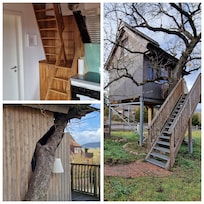
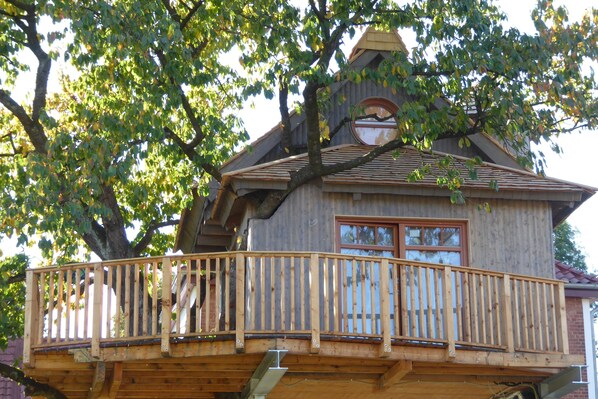
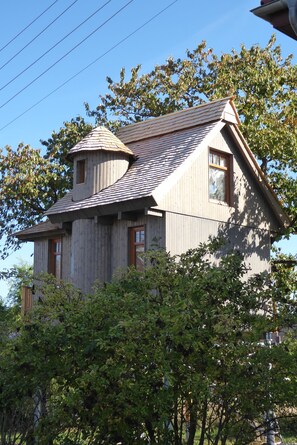
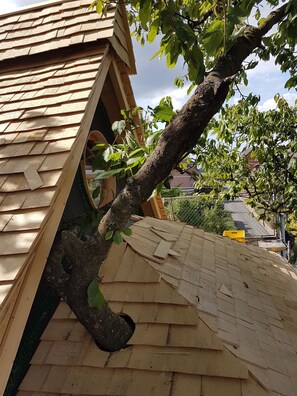
Our treehouse is built in and around an old cherry tree. However, it does not put any strain on the tree; it is elevated on stilts and constructed using a timber-frame design. Screw piles were chosen as the foundation to avoid damaging the tree’s roots.
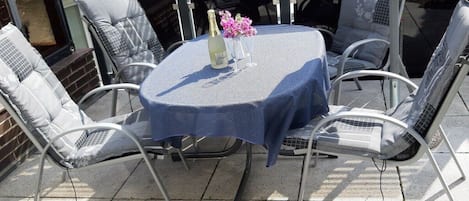
The exterior is made of oiled spruce, and the roof is made of untreated Canadian cedar. We chose larch wood for the large deck. Access to the house is via a wide staircase, which is very convenient and leads directly from the private parking space next to the house.
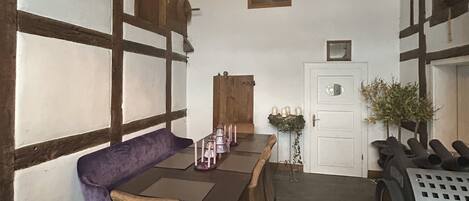
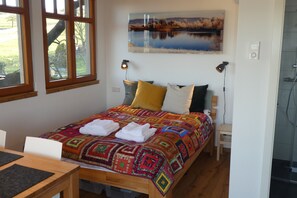
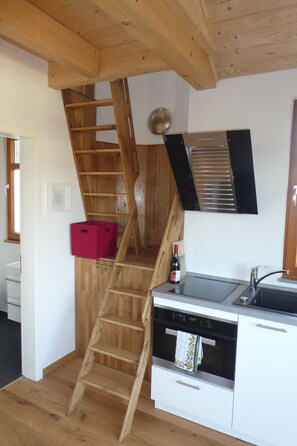
Inside, you’ll find modern, high-quality furnishings, including a bathroom, kitchenette, dining area, and a large bed on the lower level. A safe and easy-to-navigate staircase, built into a small tower, leads to the upper level. There you’ll find the attic with another large bed. A lockable child safety gate ensures the safety of little ones.
The entire house is built to be allergy-friendly; this applies to all materials used. Therefore, we are unfortunately unable to accommodate dogs in the house. We ask all dog owners for their understanding, but unfortunately, many guests would have a problem with this.
The vacation home is designed for four people—young or old—and is fully equipped with everything you need: freshly made beds, plenty of towels and toiletries, as well as everything you need in the kitchen. To stay connected to the outside world, feel free to use our free Wi-Fi and the phone (landline calls included).
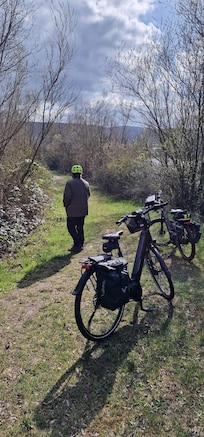
The entire property (750 m²) is at your exclusive disposal. It consists mainly of green space, is completely fenced in, and offers plenty of room for children to play. A small shed is available for storing bicycles.
Our guestbook and Wi-Fi welcome page provide information about nearby shopping options, lovely restaurants, great hiking trails, the floodplain landscape along the Weser River, and many other wonderful things you can experience here with us.
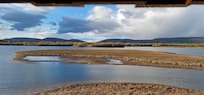
The treehouse is located in the village of Hohenrode, which is part of Rinteln. From above, you have a direct view of the floodplain of the same name, a nature conservation project run by NABU: the Hohenrode Floodplain. The floodplain is situated in a bend of the Weser River; it is home to a wide variety of bird species—some of which are very rare—and serves as an important resting and overwintering area for migratory birds.
It is nestled within the Weserbergland Nature Park, the northern low-mountain range landscape of Lower Saxony. The landscape of the Weserbergland Nature Park is characterized by the course of the Weser River, extensive forests, and magnificent views of a diverse environment: Weserbergland Nature Park.
Hohenrode is one of the oldest church villages in the Weser Valley and was first mentioned in connection with the founding of the Möllenbeck Monastery in 896. Its church, more than 1,000 years old and featuring Romanesque, Gothic, and Baroque architectural elements, bears witness to this long history.
About 8 km to the west, along the Weser River, lies Rinteln. With its small but charming old town, the city is considered a gem of the Weser Renaissance (1520 to 1620). The historic center, with its market square, is magnificently adorned with bay windows, French gables, shell ornaments, fan rosettes, volutes, cornices, and plenty of half-timbering: Rinteln. Here you’ll find all the necessary shopping options. In Exten—on the way there (4 km)—there are also two bakeries.
Hameln lies about 19 km away, eastward along the Weser. Hameln gained worldwide fame through the exodus of the “Children of Hameln” (1284), which later gave rise to the well-known legend of the Pied Piper. Even today, Hameln is known worldwide for this story and attracts many tourists to its historic old town every year. The magnificent buildings of the Weser Renaissance can still be admired today and define the charm of the picturesque old town.