


Deals on vacations and trips to Pyatovskoe

Save when you book Pyatovskoe package deals

Choose two or more items and save on your trip:

Frequently asked questions

How much are vacation packages to Pyatovskoe?
Your vacation fantasies can become reality in Pyatovskoe from as little as . Vacation packages include flights and hotels, and they'll make booking your trip a breeze. The only thing you'll need to concentrate on is what amazing attraction you'll head to first.
Where can I get the best vacation package deals for Pyatovskoe?
You'll find fantastic Pyatovskoe package deals with Travelocity. Mix and match from 400 airlines and 1,000,000 worldwide properties and turn your travel dreams into reality.
Why should I book my Pyatovskoe vacation bundle with Travelocity?
Savings, support and a stress-free booking are just the tip of the iceberg. Collect lifelong memories and enjoy a fulfilling travel experience knowing you can rely on our team of customer support experts around-the-clock. With the Travelocity Price Match Guarantee, you can relax knowing you'll always get the best deal available.
Will I save money on my Pyatovskoe car rental if I book it with a hotel or flight?
Bundling your bookings into a Pyatovskoe vacation package will save you a tidy sum. You can combine a flight and car; a car, hotel and flight; or a hotel and car. You won't find a better way to discover the greater Pyatovskoe area than from the comfort of your own rental car. You can also add experiences and tours to your Travelocity package.

Photos of local treasures

Browse Pyatovskoe vacation photos for more inspiration
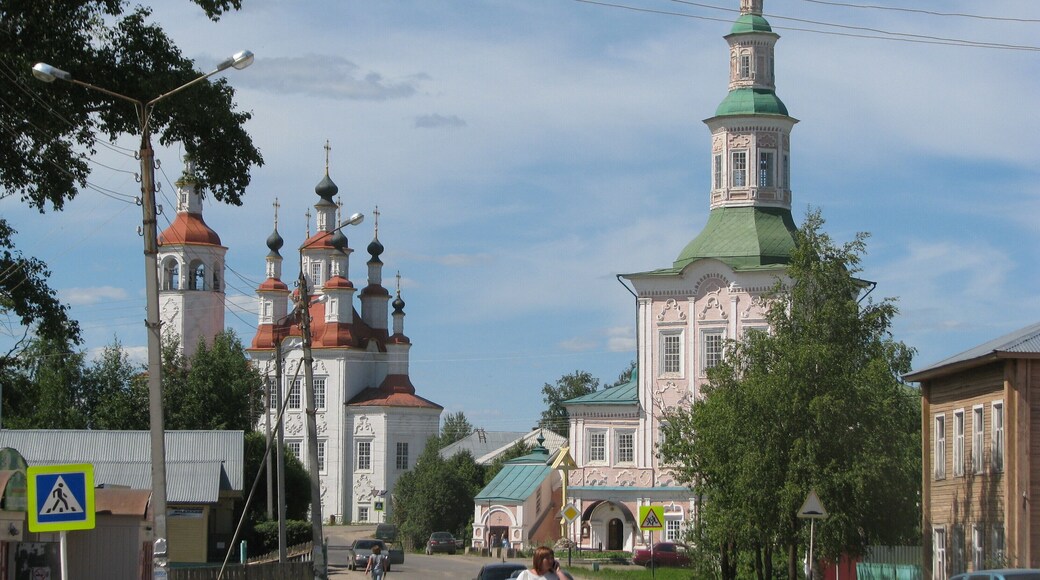
Totma’s founding date is considered to be the year 1137, on the basis of a letter from the Novgorod Prince Svyatoslav Olgovich. 
From the 15th century until the 18th century, Totma remained one of the largest salt cities and at one time was also called Posad Salt Totemskaya or Totemskaya Salt. The 17th century becomes the heyday for Totma, as well as for other cities on the North Dvina waterway. Virtually all foreign trade of the Russian state, due to the lack of access to the Baltic Sea, was carried out through Vologda, Totma, Veliky Ustyug and Arkhangelsk, which contributed to the appearance in Totm of courtyards and representative offices of foreign merchants and trade missions. In just one year, from 500 to 1000 ships passed through the city [6]. The trade value of the city, which was strengthened due to the further development of salt mines, allowed Totme to be one of the richest and most important cities of the Russian kingdom. In the second half of the 18th century, a total of expeditions to the east — to Siberia, to the Far East, and to the shores of the Americas — were carried out by the Totmichians — Kholodilovs, Panovs, Cherepanovs, and a number of others. Companies totem merchants outfitted about 20 expeditions into the Pacific. During these expeditions geographical discoveries were recorded, recorded by science in 1755, maps of a number of islands were made. These expeditions exported 1/5 of all fur produced in the Americas for half a century - a record figure among Russian cities [6]. Fur trade brought tangible profits; so, with the money raised in Siberia, the Totem merchants and sailors had the opportunity to build richly decorated and large enough temples for such a small town: Entrance to Jerusalem, Trinity, Rozhdestvensky. In 1785, Empress Catherine II adopted a decree on giving Totme a coat of arms with a black fox on a golden field: “as a sign of the fact that the inhabitants of this city catch these animals in fishing” [6]. Totmichi proved to be active participants of the Russian-American company, mastered the expanses of the Pacific Ocean, discovered a number of Aleutian and Commander Islands [6]. Totmich Ivan Kuskov on the coast of Northern California near Bodega Bay Bay in 1812, Fort Ross Fortress was founded, which became the most southerly point of Russian America.
Totma’s founding date is considered to be the year 1137, on the basis of a letter from the Novgorod Prince Svyatoslav Olgovich. 
From the 15th century until the 18th century, Totma remained one of the largest salt cities and at one time was also called Posad Salt Totemskaya or Totemskaya Salt. The 17th century becomes the heyday for Totma, as well as for other cities on the North Dvina waterway. Virtually all foreign trade of the Russian state, due to the lack of access to the Baltic Sea, was carried out through Vologda, Totma, Veliky Ustyug and Arkhangelsk, which contributed to the appearance in Totm of courtyards and representative offices of foreign merchants and trade missions. In just one year, from 500 to 1000 ships passed through the city [6]. The trade value of the city, which was strengthened due to the further development of salt mines, allowed Totme to be one of the richest and most important cities of the Russian kingdom. In the second half of the 18th century, a total of expeditions to the east — to Siberia, to the Far East, and to the shores of the Americas — were carried out by the Totmichians — Kholodilovs, Panovs, Cherepanovs, and a number of others. Companies totem merchants outfitted about 20 expeditions into the Pacific. During these expeditions geographical discoveries were recorded, recorded by science in 1755, maps of a number of islands were made. These expeditions exported 1/5 of all fur produced in the Americas for half a century - a record figure among Russian cities [6]. Fur trade brought tangible profits; so, with the money raised in Siberia, the Totem merchants and sailors had the opportunity to build richly decorated and large enough temples for such a small town: Entrance to Jerusalem, Trinity, Rozhdestvensky. In 1785, Empress Catherine II adopted a decree on giving Totme a coat of arms with a black fox on a golden field: “as a sign of the fact that the inhabitants of this city catch these animals in fishing” [6]. Totmichi proved to be active participants of the Russian-American company, mastered the expanses of the Pacific Ocean, discovered a number of Aleutian and Commander Islands [6]. Totmich Ivan Kuskov on the coast of Northern California near Bodega Bay Bay in 1812, Fort Ross Fortress was founded, which became the most southerly point of Russian America.